Voyager
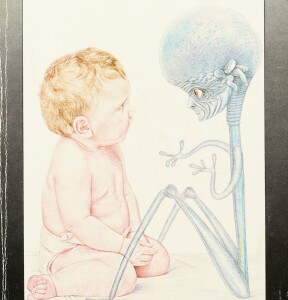
How do you communicate with people whose language won’t share any human languages’ roots? Will aliens even share our range of sensory perceptions? How can we leave instructions to help them decode what we send them?
The probes Voyager 1 and Voyager 2 were launched by NASA in 1977, to gather scientific information about the gas giants Jupiter and Saturn. But both probes exceeded their expectations and have continued to transmit data from interstellar space, and will continue to do so until their power runs out in the 2030s. They are the only human-made objects to have left the solar system, and Voyager 1 is the farthest human-made object from Earth.
Because their trajectory would take them out of the Solar System, the Voyager probes were both equipped with a Golden Record, which contain images and sounds representing the diversity of life on Earth, intended for any form of extraterrestrial life that may find them. The contents include greetings in various human languages, images and sounds of humans and nature, and music from various cultures.
2027 will mark fifty years since the Voyager probes were launched. Inspired by the Voyager missions, this exhibition uses items housed in the University of Liverpool’s Science Fiction Collections to explore how science fiction has imagined the problems that could arise when trying to communicate with aliens, and how we might overcome them.
Voyager
How do you communicate with people whose language won’t share any human languages’ roots? Will aliens even share our range of sensory perceptions? How can we leave instructions to help them decode what we send them?
The probes Voyager 1 and Voyager 2 were launched by NASA in 1977, to gather scientific information about the gas giants Jupiter and Saturn. But both probes exceeded their expectations and have continued to transmit data from interstellar space, and will continue to do so until their power runs out in the 2030s. They are the only human-made objects to have left the solar system, and Voyager 1 is the farthest human-made object from Earth.
Because their trajectory would take them out of the Solar System, the Voyager probes were both equipped with a Golden Record, which contain images and sounds representing the diversity of life on Earth, intended for any form of extraterrestrial life that may find them. The contents include greetings in various human languages, images and sounds of humans and nature, and music from various cultures.
2027 will mark fifty years since the Voyager probes were launched. Inspired by the Voyager missions, this exhibition uses items housed in the University of Liverpool’s Science Fiction Collections to explore how science fiction has imagined the problems that could arise when trying to communicate with aliens, and how we might overcome them.

